
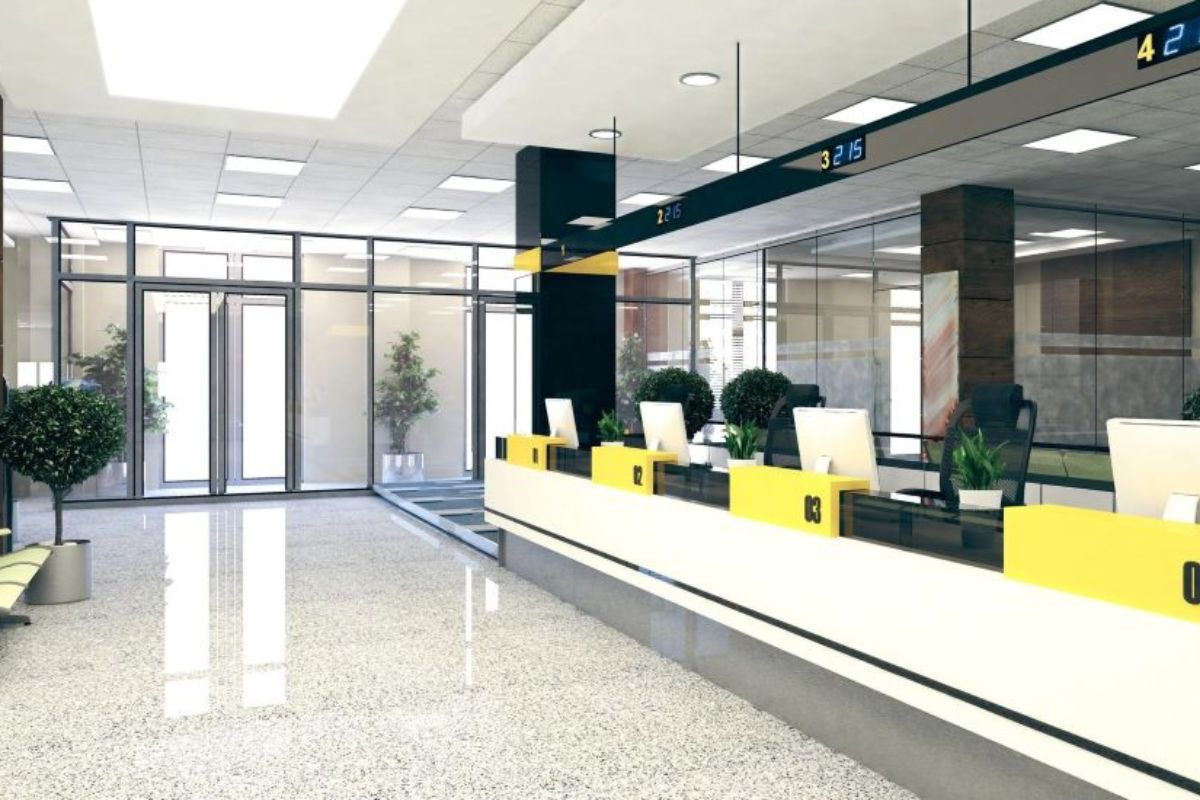
Banks and financial institutions are no longer just places for routine transactions; they’re evolving into digital-first experience hubs. Today, smart bank interior design plays a decisive role in shaping customer trust, improving service speed, and enabling modern banking journeys where spatial planning and technology work seamlessly together.
Even with the growth of digital channels, physical branches still matter. They remain essential for complex onboarding, financial advisory discussions, and high-trust interactions that customers prefer to handle in person. But when a branch or financial office interior is poorly planned, the consequences extend far beyond aesthetics. It becomes a functional barrier: queues get longer, staff efficiency drops, customers feel frustrated, and ultimately the branch’s ROI takes a hit.
Thoughtful financial office interior design is no longer optional, but a strategic tool for delivering smoother operations and future-ready customer experiences.
Below, we unpack the most common bank interior design mistakes that slow down service, show how those mistakes create real operational pain, and give practical design fixes you can apply across single branches or an entire network
Mistake: Rigid, Transactional Floorplans
Why does it slow service: Traditional linear layouts, such as long counters, fixed teller rows and narrow aisles, force every customer through the same choke points. Peak times create bottlenecks; staff movement is constrained; simple tasks take longer.
Fix: Move to a flexible zoning model. Create distinct service paths for quick transactions, advisory conversations and self-service. Introduce modular counters and reconfigurable furniture so the branch can scale by demand, not by demolition.
Mistake: Poorly Placed Service Touchpoints
Why does it slow service: When ATMs, kiosks, consultation rooms, and teller counters are scattered without logical sequencing, customers wander, staff get interrupted and handoffs fail. Confusion equals time lost.
Fix: Map the customer journey physically. Place quick-service kiosks near the entry, advisory rooms deeper in the zone, and teller counters where staff have clear sightlines. Use signage and digital wayfinding to guide flows.
Mistake: Neglecting Acoustics and Privacy
Why does it slow service: Open, echoing branches make private conversations difficult and increase repeats: customers ask questions again, staff ask colleagues for clarifications, and calls are less efficient. High noise equals low first-call resolution.
Fix: Use acoustic baffles, soft-finish materials, and dedicated consultation rooms. Design enclosed spaces for sensitive conversations and sound-buffered zones for high-traffic call or demo areas.
Mistake: Inadequate Integration of Technology & AV
Why does it slow service: Tech is placed as an afterthought in some interior designs of modernised banks. Kiosks without shelter, screens without AV support, or meeting rooms with poor connectivity can turn helpful tools into disruptions. Staff waste time troubleshooting rather than servicing customers.
Fix: Design technology into the architecture from day one: concealed cabling, cooling for kiosks/servers, AV-tested meeting rooms, and easy-to-use customer-facing interfaces. Consider staff training zones adjacent to tech-heavy areas so troubleshooting doesn’t block service lanes.
Mistake: Ignoring Staff Ergonomics and Back-of-House Flow
Why does it slow service: If staff workstations are cramped, poorly lit, or placed far from core service areas, productivity drops and response times increase. Back-of-house inefficiencies cascade into slower customer responses.
Fix: Design ergonomic workstations, direct staff circulation routes, and compact utility zones (document handling, vault access) that minimise movement. A happier, less fatigued team speeds service.
Mistake: Overlooking Queue Design & Waiting Experience
Why does it slow service: Long, unclear queues create anxiety and escalate perceived wait times. Frustrated customers are harder to serve and more likely to escalate simple issues.
Fix: Design visible, single-flow queues where possible. Provide comfortable seating, digital queue updates, and small engagement points (ATMs, info screens, self-serve kiosks) to reduce perceived waits.
Why Bank’s Branch Interior Design Matters Now
Banks are not abandoning branches, but they are reimagining them. While digital adoption continues to grow, real-world evidence shows physical branches still play a crucial role in acquiring customers and servicing complex needs. Several Indian banks are expanding or upgrading branches as part of a hybrid strategy that balances digital channels with physical touchpoints; others are investing in branch modernisation to comply with regulatory and tech requirements. Designing branches that blend speed, privacy, and digital tools is therefore a high-impact investment for network optimisation and customer experience.
Practical Checklist: Design Moves That Deliver Faster Service
Map the customer journey and design physical touchpoints to match (entry → quick-service → advisory → exit).
- Zone for purpose: fast lanes, advisory zones, self-service hubs, and staff-only circulation.
- Design technology into the build: cabling, cooling, and AV-ready rooms.
- Prioritise acoustics: soft finishes, sound-absorbing panels, and enclosed rooms for sensitive conversations.
- Build flexibility: modular furniture, movable partitions and plug-and-play workstations for rapid scaling.
- Measure & iterate: track service TAT and NPS post-fitout; iterate based on actual behaviour.
Quick Case-In-Point (How Design Translates to ROI)
A branch that replaces one large counter with three modular service points, introduces two advisory rooms, and adds queue displays typically sees measurable improvements: shorter transaction times, higher onboarding conversions and an uplift in customer satisfaction scores. The cost of targeted redesign is often recovered in 12–24 months through reduced staffing strain, faster throughput and improved product conversions.
FAQs
Q: How soon can a branch be redesigned without major downtime?
A: With modular solutions and phased rollouts, many branches can be upgraded in stages with minimal service disruption, often completing core changes within 4–6 weeks, depending on scale.
Q: Will redesigning physical branches still matter if most customers go digital?
A: Yes. Physical branches still drive complex onboarding, wealth conversations and trust-building. A well-designed branch complements digital channels and improves customer acquisition for high-value products.
Q: How do we measure whether a financial office interior design change improved service?
A: Track metrics like average transaction time (TAT), queue length, customer NPS/CES, and conversion rates for advisory products before and after redesign.
Q: Are modular interiors more expensive long-term?
A: Modular interiors can cost slightly more upfront, but they drastically reduce future refit costs, improving long-term TCO and enabling faster network adaptation.
Final Thought: Where to Begin
If you’re deciding whether to redesign, start with a pilot: choose a representative branch, map customer journeys, and test modular layout variants. Measure results and scale the model across your network. Design isn’t cosmetic here; it’s operational strategy.
Whitehills Interior is one of India’s leading commercial interior design firms with proven experience in designing and building high-performing BFSI workplace interiors. If you want help turning branch redesign into measurable operational gains, Whitehills will be your trusted partner. Design, Plan, and Execute: All under one roof.
Sources:
https://www.finantrix.com/the-future-of-physical-branches-in-the-digital-age/
https://www.capco.com/intelligence/capco-intelligence/top-5-banking-trends-for-india-2025